Checked by realLaw AI
Cryptocurrency regulation in the UAE
The United Arab Emirates is actively developing its economy and strengthening its position as one of the world's centers of innovation and technology. In this regard, regulation of cryptocurrencies is an important aspect to ensure innovative development, investor protection and financial stability.
At the current stage, legislative regulation of cryptocurrency in the UAE is not yet centralized. Depending on the jurisdiction and type of activity, regulation is carried out by various entities within its own jurisdiction over virtual assets. Read more about the regulatory bodies in our Virtual Assets overview.
Cryptocurrency marketing is a separately regulated sphere. Read more about the relevant regulations in our review Advertising Restrictions in the UAE.
Legislative basis of cryptocurrency regulation
Federal level
- Cabinet Decision No. 111 of 2022 on Regulation of Virtual Assets and their Service Providers contains detailed rules for the regulation of virtual assets (which also include cryptocurrencies) and their service providers.
- Cabinet Decision No. 112 of 2022 Regarding the Delegation of Certain Powers Related to the Regulation of Virtual Assets is related to ensuring security standards and countering risks associated with virtual assets, including cryptocurrencies.
- Federal Decree-Law No. 10 of 2025 On Combating Money Laundering, Terrorist Financing and Proliferation Financing regulates AML/CFT requirements, including requirements applicable to Virtual Asset Service Providers and transactions involving virtual assets..
- CBUAE Circular No. 2 of 2024 on Payment Token Services Regulation establishes the rules and conditions determined by the Central Bank for the issuance of a license or registration for providing payment token services, including cryptocurrencies, and related issues.
Payment Token Services are digital payment services in the UAE and comprise three categories, namely Payment Token Issuance, Payment Token Conversion and Payment Token Custody and Transfer. Providing these services is a financial activity subject to licensing and regulation by the Central Bank in accordance with the provisions of the Federal Decree-Law No. 6 of 2025 Regarding the Central Bank, Regulation of Financial Institutions and Activities, and Insurance Business.
- Securities and Commodities Authority Decision No. 11 of 2021 Concerning Guidance for Crypto Asset Regulations applies to most forms of Crypto Assets whether securities or otherwise, which are listed and available for trading on an organised market.
The Regulation does not apply to items regulated by the UAE Central Bank, which, as of the date of this guide, apply to stored value facilities and Payment Token (which broadly captures stable-coins/tokens backed by fiat currency). It covers the SCA regulated Financial Activities in respect of Crypto Assets in the UAE that include: promotion and marketing, issuance and distribution, advice, brokerage, custody and safekeeping, fundraising, operating an exchange.
The Decision sets the rule that SCA authorization is required to list a crypto asset on a regulated cryptocurrency exchange, except in the case of listing crypto assets on exchanges that are only allowed to work with qualified investors. The Decision also covers rules on licensing of crypto asset-related activities, conduct of business, mandatory disclosure and cryptocurrency exchange rules.
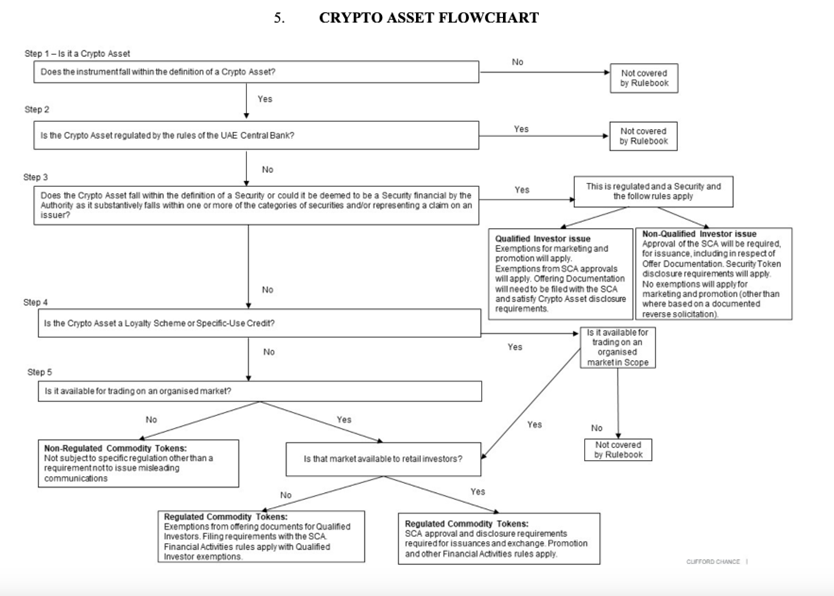
Crypto asset flowchart — Securities and Commodities Authority Decision No. 11 of 2021 Concerning Guidance for Crypto Asset Regulations
- The Chairman of the CMA’s Board of Directors’ Decision No. 04/ R.M of 2026 Concerning the Regulation of Virtual Assets Service Providers and the Alternative Trading System Operator sets a robust, unified legal framework that classifies virtual assets, bans anonymous tokens, and mandates strict licensing and capital requirements for all service providers in the UAE.
Level of the Emirates
Dubai
VARA
In the Emirate of Dubai, the Virtual Assets Regulatory Authority (VARA) is a specialized body that regulates virtual assets, including cryptocurrencies. VARA is responsible for licensing, monitoring and controlling the activities of virtual asset companies. VARA's regulations apply all over the Emirate, including special development zones and free zones, with the exception of the Dubai International Financial Centre (DIFC).
VARA issues official documents on a regular basis, including related to the regulation of cryptocurrencies:
- Virtual Assets and Related Activities Regulations stipulate the concept of Anonymity-Enhanced Cryptocurrencies, a type of virtual asset that does not allow traceability of transactions and for which virtual asset service providers (VASPs) do not have mechanisms to trace or identify ownership. Under the Regulations, the issuance of Anonymity-Enhanced Cryptocurrencies and all related activities is prohibited in the UAE.
- Virtual Asset Issuance Rulebook supplements the Regulations on Virtual Assets and Related Activities. In particular, it clarifies that the concept of “transactions with enhanced anonymity” means transactions with Virtual Assets that are not Anonymity-Enhanced Cryptocurrencies but that prevent transactions from being traced.
- Compliance and Risk Management Rulebook. According to the Rulebook, business risk assessment includes the identification and assessment of AML/CFT risks in connection with the development and use of new or existing virtual assets, in particular Anonymity-Enhanced Cryptocurrencies.
DIFC
Within the Dubai International Financial Centre (DIFC), financial services involving Crypto Tokens are regulated by the Dubai Financial Services Authority (DFSA). Under the updated Crypto Token framework effective from 12 January 2026, firms are responsible for assessing whether the Crypto Tokens they use are suitable in accordance with the criteria set out in GEN Rule 3A.2.1. The DFSA no longer maintains a prescribed list of Recognised Crypto Tokens. Firms must conduct and document their own suitability assessments and monitor them on an ongoing basis, taking into account the DFSA Supervisory Guidelines on Assessing the Suitability of Crypto Tokens. In particular, the DFSA has published a number of documents on crypto-tokens:
- DFSA Conduct of Business Module COB
- DFSA Authorised Market Institutions AMI
- DFSA Collective Investment Rules CIR
- DFSA Anti-Money Laundering, Counter-Terrorist Financing and Sanctions Module AML
- DFSA Code of Market Conduct (CMC)
Abu Dhabi
In Abu Dhabi mainland, virtual assets (including cryptocurrencies) are regulated by the federal laws. There is no separate authority for Abu Dhabi mainland that deals exclusively with virtual assets (unlike the ADGM Free Zone).
ADGM
Within the ADGM Free Zone virtual assets are regulated by the Financial Services Regulatory Authority (FSRA). FSRA has developed one of the world's first comprehensive regulatory regimes for cryptocurrencies collectively known as Crypto Asset Legislative Framework, which includes licensing, capital requirements and risk management.
In addition, FSRA also published the following documents:
- Guidance Regulation of Crypto Asset Activities in ADGM,
- Regulation of Virtual Asset Activities in ADGM which includes regulatory requirements for conducting business related to crypto assets, cryptocurrency exchanges and cryptocurrency custodianship.
Ras Al Khaimah
In Ras Al Khaimah mainland the regulation of virtual assets, including cryptocurrencies, is carried out in accordance with the federal laws (there is no separate specialized government entity tasked with this type of regulation).
It is worth noting that RAK Digital Assets Oasis Companies Regulations 2023 stipulate the opportunity for a company in this free zone to have a share capital in cryptocurrency. In this case, a shareholder will be a person who owns cryptocurrency assets and intends to contribute their assets (which include cryptocurrency) as an in-kind contribution to the shared capital of the company. This means that in exchange for the cryptocurrency asset transferred to the company, the shareholder will receive a certain percentage of shares for such in-kind contribution. The in-kind contribution must meet the relevant requirements, such as the possibility of its accurate evaluation by an independent auditor.
The Emirates of Sharjah, Ajman, Umm al Quwain and Fujairah do not have formalized regulation of virtual assets.
Restrictions for natural and legal persons on sending and receiving cryptocurrency payments
Federal regulations
Natural persons are allowed to conduct cryptocurrency transactions without a license if they act solely on their own behalf, do not provide services to third parties and are not engaged in commercial activities.
For example, if an individual transfers cryptocurrency to friends or relatives, uses it for personal purchases or settlements, without acting as an intermediary and without deriving any profit from it, no license is required. The basis for this is Article 1 of Cabinet Decision No. 111 of 2022 that determines Virtual Asset Service Providers (VASPs) as legal entities engaged in regular commercial activities.
However, if an individual starts receiving funds from others and transfers cryptocurrency on their behalf, or if the activities are conducted on a regular basis and lead to profit, the individual falls under the above definition of a VASP and must obtain the appropriate license. This is stipulated in Articles 3 and 5 of the aforementioned Decision, which sets the obligation to receive authorization before carrying out regular commercial activities.
Legal entities are required to obtain a license for the following activities (according to Article 5(1) of Cabinet Decision No. 111 of 2022):
- cryptocurrency exchange,
- transfers of digital assets,
- storage and management of cryptocurrencies,
- providing financial services using cryptocurrencies.
In the UAE, companies are allowed to open crypto accounts on authorized crypto exchanges. However, in practice, it is difficult to withdraw funds from crypto exchange accounts to standard bank accounts as it is difficult to determine the original source of the withdrawn funds.
The UAE has restrictions on the types of transactions and purchase of goods/services for legal persons:
- Anonymous transactions are prohibited. Financial Institutions and Virtual Asset Service Providers are required to conduct customer identification and due diligence and are prohibited from opening or maintaining anonymous accounts or accounts under clearly fictitious names (Cabinet Decision No. 134 of 2025).
- Cryptocurrency cannot be used to pay for goods and services without a license. Although there is no direct reference to the prohibition of the use of virtual assets as a means of settlement without a license in the regulations that are already mentioned above, any person engaged in VASP activities must be licensed by the relevant supervisory authority. Thus, accepting payments in cryptocurrency for goods and services may be considered as VASP activity requiring a license.
- It is prohibited to accept cryptocurrency as payment without the appropriate authorization. Persons and organizations accepting cryptocurrency as part of business are required to obtain a license as virtual asset service providers (Cabinet Decision No. 111 of 2022).
Dubai (VARA)
In Dubai, Dubai Law No. 4 of 2022 is enacted to regulate virtual assets. Its implementation is entrusted to the Virtual Assets Regulatory Authority (VARA).
The law directly applies to both natural and legal persons: everyone engaged in activities with virtual assets must comply with VARA's unified registration and licensing requirements, regardless of their legal type.
In accordance with Article 16 of the Law, the VARA’s license is required in the following cases:
- exchange of cryptocurrencies and other virtual assets,
- providing financial services based on crypto assets,
- management or custody of cryptocurrencies,
- providing transfer, exchange, clearing and settlement services, etc.
Аbu Dhabi (ADGM)
A key feature of regulation in the ADGM is that virtual assets (including cryptocurrencies and tokens) are treated as a separate class of investment products. Dealing in them falls under the regulation of financial activities.
A FSRA license is required for any natural or legal person that conducts regulated activities with virtual assets in the ADGM on a commercial basis. According to the latest FSRA guidelines, such activities include:
- cryptocurrency exchanges (fiat-to-crypto and crypto-to-crypto), including through trading platforms;
- storage of crypto assets and custodial services;
- brokerage and advisory activities with digital assets;
- investment management related to virtual assets;
- issuance of tokens if it is of an investment nature.
Restrictions for natural and legal persons are the following:
- Natural persons: there are no direct restrictions for individuals when sending and receiving cryptocurrency payments. However, using the services of unlicensed platforms or engaging in unregulated transactions may result in legal consequences.
- Legal persons: companies operating with crypto assets without the appropriate license from FSRA may face penalties, including fines and suspension of operations.
Penalties for violations
Federal level
Sending or receiving cryptocurrencies without a license or outside the scope of authorized activities:
- a fine of up to AED 10,000,000 (Article 12 of Cabinet Decision No. 111 of 2022);
- additional fines of up to AED 4,000,000 and suspension of activities (item 1 of the table of Cabinet Decision No. 99 of 2024).
Interaction with a person who engages in activities with virtual assets in the UAE without a license:
- a fine of up to AED 800,000 (item 4 of the table of Cabinet Decision No. 99 of 2024 - failure to comply with transaction identification requirements).
The transaction is used to finance terrorism, circumvent sanctions or launder the proceeds of crime:
- possibility of criminal liability (Federal Decree-Law No. 10 of 2025).
- imprisonment for up to five years and/or a fine ranging from AED 250,000 to AED 1,000,000,000, as well as the issuance of a court order for the confiscate seized funds in case a person engages in the promotion of cryptocurrencies without a license from the relevant authorities;
- imprisonment and/or payment of a fine ranging from AED 20,000 to AED 500,000 in case the person engages in advertising, distributing, brokering, trading or promoting the trading of virtual currency, cryptocurrency without a license from the competent authority.
Dubai (VARA)
VARA may impose financial penalties. The amount of administrative fines for specific violations is set by a decision of the VARA Board of Directors (pursuant to Article 20(a) of Dubai Law No. 4 of 2022).
In addition to fines, VARA is authorised to:
- suspend the license for up to 6 months;
- revoke the license, followed by an application to the competent authority in Dubai to cancel the commercial license (Article 20(b) of Dubai Law No. 4 of 2022).
Dubai (DIFC)
The amount of fines in DIFC is not fixed in the laws. Fines are determined during administrative proceedings or by a decision of the DIFC courts depending on the nature and severity of the violation.
In addition to fines, the DFSA (which regulates activities with virtual assets in the DIFC financial zone) is authorised to:
- suspend or revoke a license;
- issue a formal warning;
- refer the matter to the DIFC courts.
Abu Dhabi (ADGM)
FSRA has authority to control and impose penalties. The amount of fines is determined on a case-by-case basis and is not specified as fixed amounts in laws. In case of serious violations, large fines may be imposed through administrative proceedings.
In addition to fines, FSRA is authorized to:
- suspend or revoke a license;
- issue a formal warning;
- transfer information to law enforcement agencies;
- publish information about the violator on the ADGM website (naming and shaming policy).
Taxation of Cryptocurrency Transactions
Corporate Tax
The terms “cryptocurrency”, “virtual assets” or “digital assets” are not explicitly used in Federal Decree-Law No. 47 of 2022 on the Taxation of Corporations and Businesses, but the definitions in Articles 1 and 11 of the Decree-Law allow cryptocurrency activities to be interpreted as “business activities” if they meet the criteria of commercial activity.
Under the provisions of Federal Decree-Law No. 47 of 2022 on the Taxation of Corporations and Businesses, it can be concluded that if cryptocurrency activity is conducted on a regular basis and for the purpose of making a profit, it may be considered “business activity” and subject to Corporate Tax.
Accordingly, cryptocurrency activities:
- may be subject to Corporate Tax: 9% on profits exceeding AED 375,000 (Article 3 of the Decree-Law);
- are taxable: if cryptocurrency activity (e.g., trading, asset management, exchange, platform operations) is conducted on an ongoing basis and generates profit. In this case, it may be considered “business activity” and be subject to Corporate Tax (9%). Corporate tax rate: 9% on profit exceeding AED 375,000 (Article 3 of the Decree-Law). For more details on free zones, payments and exemptions, refer to our Corporate Tax overview;
- are not taxable: if they constitute personal investments in cryptocurrency by individuals without engaging in commercial activity. If an individual trades cryptocurrency personally (not through a company, not on behalf of a business) and it is not a systematic activity, then, according to Article 11(6) and Article 1, the individual may not be considered a taxpayer. However, if the crypto activity becomes regular and organized — for example, through a platform or an account registered as a freelancer — it may be qualified as a business.
Holding cryptocurrency, transferring between wallets or passive ownership is not considered a taxable activity — as long as there is no profit, income or business structure.
If a company receives cryptocurrency as payment for goods or services, such income is still taxable — the cryptocurrency must be valued in AED at the time of the transaction. This follows from the general provisions of Corporate Tax: any income received in any form, including in-kind and digital assets, must be recorded at fair value in AED.
It is important to note that according to Ministerial Decision No. 336 of 2025, Dubai Virtual Asset Regulatory Authority (VARA) has been officially recognized as the competent authority for the preferential tax regime related to the Corporate Tax for the Wealth and Investment Management and Fund Management activities.
VAT on Cryptocurrency Transactions
The key document is Federal Decree-Law No. 8 of 2017 on Value Added Tax and its Executive Regulations. In these documents, cryptocurrencies are referred to via the term “Virtual Assets”.
- Financial services related to cryptocurrencies may be exempt from VAT (Article 42 of the Executive Regulations clarifies that the transfer, exchange, custody and management of virtual assets may fall under financial services that are zero-rated or exempt from VAT if certain conditions are met).
- If cryptocurrency is used to pay for goods or services, the transaction may be subject to 5% VAT (Article 3 of the Decree-Law). VAT is not charged on the cryptocurrency itself, but on the good or service paid for with it. The exchange rate used in such cases is not legally established but, in practice, the market rate at the time of the transaction is applied.
- Cryptocurrency mining: according to Federal Tax Authority VAT Public Clarification VATP039 of 2025 on cryptocurrency mining, if a person mines cryptocurrency for their own account, it is not considered a taxable activity in the UAE and not qualified as a taxable supply — VAT is not applicable in this case. If the person provides mining services to others for consideration, this constitutes a taxable service and is subject to VAT.
- Recovery of input VAT: a person engaged in cryptocurrency mining may incur expenses in connection with their mining activity, including the purchase of equipment, commercial rent, utilities and maintenance. If the person mines for others, they may be entitled to recover input VAT. If the person mines for their own account, such expenses are not considered as incurred for taxable supplies, and input VAT cannot be recovered.
Penalties for Non-Compliance with Corporate Tax Requirements
Pursuant to Cabinet Decision No. 75 of 2023 on Administrative Penalties for Violations Related to Federal Decree-Law No. 47 of 2022 on the Taxation of Corporations and Businesses, the following penalties are established:
- Failure to maintain records: AED 10,000 per violation; AED 20,000 for a repeated violation within 24 months.
- Failure to submit data and documents upon request: AED 5,000.
- Late application for deregistration: AED 1,000 per month of delay, up to a total of AED 10,000.
- Failure to notify changes in tax information: AED 1,000 per violation; AED 5,000 for a repeated violation within 24 months.
- Late submission of tax returns: AED 500 for the first 12 months; AED 1,000 for each subsequent month.
- Failure to pay tax: 14% annual interest on unpaid amounts from the first day of delay.
- Violation of tax audit requirements: AED 20,000.
Penalties for Non-Compliance with VAT Requirements
Pursuant to Cabinet Decision No. 40 of 2017 on Administrative Penalties for Violations of Tax Legislation in the UAE, the following penalties, among others, are provided:
- Price displayed without VAT: AED 5,000.
- Failure to issue a tax invoice or alternative document: AED 5,000 per invoice or document.
- Failure to issue a credit note: AED 5,000 per document.
- Non-compliance with electronic invoicing and credit note requirements: AED 5,000 per incorrect document.
Exchange of Tax Information on Cryptocurrencies
In 2025, the UAE Ministry of Finance signed the Multilateral Competent Authority Agreement on the Automatic Exchange of Information within the Crypto-Asset Reporting Framework (CARF). Thus, the CARF system developed by the OECD will come into force in the UAE in 2027. The first automatic cross-border data exchange is set to begin in 2028.
Exchanges, brokers and wallet providers will be required to disclose customer transaction data. Governments will be able to automatically exchange this information, tracking cross-border transactions. Consequently, the same international standards will apply to digital assets in the UAE as to bank accounts.
Court Decisions
Over the past five years, the UAE has seen the emergence of several landmark court rulings related to cryptocurrencies and blockchain technology.
Case on Salary Payment in Cryptocurrency
In 2024, the Dubai Court issued a decision in Case No. 1739 of 2024, obligating a company to pay an employee’s salary in both UAE dirhams and cryptocurrency. This followed the employee’s lawsuit for unfair dismissal.
The employee's contract stipulated a monthly salary payable in UAE dirhams and a form of cryptocurrency. The dispute involved the employer's failure to pay 5,250 tokens over six months, in addition to the dismissal claim. The court ruled in favor of the employee and ordered the company to pay the outstanding salary in both AED and cryptocurrency.
This ruling was notable as it effectively highlighted the legal feasibility of paying salaries in cryptocurrency and may serve as a precedent in future UAE court cases.
Case on Unlicensed Cryptocurrency Trading
In Criminal Cassation Case No. 452 of 2024, the Dubai court clarified the distinction between personal and commercial cryptocurrency trading.
Personal trading for investment purposes does not require licensing under virtual asset regulations but must comply with anti-money laundering (AML) rules.
Commercial trading, including exchanges, custodial services or brokerage activities, requires prior licensing from the Dubai Virtual Assets Regulatory Authority (VARA).
Failure to comply with AML or licensing requirements may result in serious penalties, including fines or imprisonment.
This key decision reflects Dubai's commitment to a clear regulatory framework for virtual assets.
Case on Cryptocurrency Investment
A decision by the Dubai Court of First Instance in Case No. 1024 of 2024 emphasized the critical importance of providing reliable evidence in cryptocurrency-related claims. Given the often opaque nature of crypto transactions, claimants must meet strict evidentiary standards to obtain a favorable judgment.
In this case, the claimant sought compensation for a failed investment, demanding USD 90,000,000 (approx. AED 330,300,000), plus 12% interest from January 23, 2023 until full payment, along with legal costs and attorney fees.
The lawsuit alleged that the defendant had persuaded the claimant to invest in Bitcoin, promising high returns if the BTC was transferred to the defendant’s Binance wallet. The claimant complied and initially received weekly reports, but the defendant eventually stopped providing updates and refused to return the cryptocurrency.
In a related criminal case, the defendant was sentenced to six months in prison, fined USD 10,000,000 and ordered to be deported. The ruling was final and confirmed by the public prosecution.
In this case, however, the court emphasized that the claimant must substantiate their claims with clear and convincing evidence, especially given the digital and often opaque nature of cryptocurrencies. The claimant's failure to provide sufficient evidence of the alleged profit and lost potential gain led to the dismissal of these claims.
Case on Cryptocurrency Theft
In Appeal No. 27 of 2024, the Dubai Court of Appeal upheld penalties in a cryptocurrency theft case, marking a significant development in the legal handling of digital assets in the UAE.
The claimant argued that the defendant had misappropriated AED 200,000 intended for cryptocurrency transactions. The defendant had already been convicted in a criminal court, fined AED 20,000 and ordered to return the stolen amount.
Nonetheless, the claimant sought additional compensation for financial losses. The Court of First Instance ruled in favor of the claimant, awarding AED 200,000 plus 5% annual interest from the date of the claim until full payment.
The defendant argued that the criminal judgment, which included restitution, precluded further civil liability under the principle of ne bis in idem (no double jeopardy). He also challenged the civil court’s jurisdiction and claimed the claimant’s evidence was insufficient.
The claimant maintained that criminal punishment does not preclude a civil claim for damages.
The Dubai Court of Appeal rejected the defendant's arguments and upheld the decision of the civil court of first instance. The court explained that the criminal court's ruling imposes a penalty for a criminal act, whereas the civil court's decision is aimed at compensating the claimant's financial losses.
The court found the civil claim to be well-founded, emphasizing that the awarded penalties differ from criminal fines and serve as adequate compensation for the claimant.
Case on Loss of Crypto Assets
A recent DIFC court ruling provided important clarity on the legal status of crypto assets by recognizing them as a distinct third category of property.
The case involved an attempted transaction in February 2020, where Gate Mena DMCC (formerly Huobi OTC DMCC) and Huobi Mena FZE agreed to sell 300 BTC to Slovak company Navarcon. To facilitate the deal and add a layer of security, the parties enlisted Tabarak Investment Capital Limited, a DIFC-based investment firm, and one of its employees as an intermediary. Under the primary agreement, Tabarak was to receive the 300 BTC from sellers in its wallet and release them to buyer, Navarcon, only after confirming receipt of the purchase funds to Tabak account. This setup aimed to protect both sides by preventing premature transfers and ensuring that sellers received their due payment.
However, Navarcon representatives insisted on using a new Trezor hardware wallet instead of transferring the funds to the Tabarak wallet, as was originally agreed upon.
Despite concerns raised by Gate Mena and Huobi representatives about the sudden deviation from the agreed protocol, the parties proceeded with the transaction using the new Trezor wallet. It was only later discovered that the Navarcon representatives had most likely exploited a vulnerability during the wallet creation process, allowing them to gain control over the BTC without making the promised payment. By the time the fraud was uncovered, 300 BTC had already been withdrawn from the Trezor wallet.
Facing the loss of their crypto assets and clear betrayal by their counterparties, Gate Mena and Huobi sought legal recourse through the DIFC courts. The plaintiffs argued that the intermediaries had failed in their obligation to safeguard the BTC and carry out the transaction according to the agreed terms.
In the first instance, the DIFC Court dismissed all claims made by Gate Mena and Huobi, ruling that the defendants had not violated any legal duties or obligations toward the plaintiffs. However, the plaintiffs were unwilling to accept this outcome and filed an appeal with the DIFC Court of Appeal, which upheld the dismissal of most of the grounds for appeal.
Bitcoin Recovery Case
In the Emirate of Dubai, an investor transferred 608 BTC (bitcoins) to a trustee as part of an investment deal, under a promise of “fantastic returns”.
According to the agreement, if the project did not materialize by a certain date, the cryptocurrency was to be returned to the investor. When the investor demanded the return of the bitcoins, the trustee refused and disappeared. The investor filed a lawsuit in Dubai, seeking the return of 608 BTC or their cash equivalent. An expert blockchain report showing the BTC transfer to a specific crypto wallet was submitted as evidence.
The Dubai Court of First Instance dismissed the claim, finding the evidence insufficient. To satisfy a claim for the return of crypto assets, the court required direct proof that the defendant controlled the address/wallet to which the bitcoins had been sent. Since such proof was not provided, the claim was rejected.
TikTok Bitcoin Mining Fraud Case
A group of criminals orchestrated a scam in Dubai, promising high returns from bitcoin mining and investments. Using TikTok videos, they lured about 180 victims across the country, collecting approximately AED 10 million in investments. In December, the victims reported the fraud to the police. The scheme was uncovered, and the case was sent to court.
The Dubai Criminal Court found seven defendants guilty of fraud. Although they faced potential prison sentences, the court limited their punishment to financial penalties: each was fined over AED 321,000 for the unlawful appropriation of funds.
This case demonstrated Dubai authorities’ willingness to crack down on cryptocurrency-related pyramid schemes.
Large-Scale Crypto Pyramid and Money Laundering (Abu Dhabi)
In 2021, authorities in Abu Dhabi uncovered an organized crime ring involving nine individuals who created a fake investment company, promising investors huge profits from cryptocurrency trading. The victims’ funds (over AED 18 million) were funneled into accounts of six controlled companies and then transferred abroad through a chain of bank transactions. The acts were classified as fraud and money laundering by an organized group.
The Abu Dhabi Criminal Court for Money Laundering Cases found all defendants guilty. Four of them were sentenced in person to 10 years in prison and fines of AED 10 million each; the remaining defendants were sentenced in absentia to the same terms. Each of the involved companies was fined AED 50 million.
The court also ordered the confiscation of all identified funds and property linked to the crime.
List of main laws
| Name | Validity of legislation |
| Federal Laws/ Decree-Laws | |
| Federal Decree-Law No. 10 of 2025 On Combating Money Laundering, Terrorist Financing and Proliferation Financing | In force |
| Federal Law No. 34 of 2021 on Combating Rumors and Cybercrimes | In force as amended on April 04, 2024 |
| Federal Decree-Law No. 47 of 2022 on the Taxation of Corporations and Businesses | In force as amended on October 01, 2024 |
| Federal Decree-Law No. 8 of 2017 on Value Added Tax | In force as amended on September 30, 2024 |
| Cabinet Decisions | |
| Cabinet Decision No. 111 of 2022 On Regulating Virtual Assets and its Service Providers | In force |
| Cabinet Decision No. 112 of 2022 On the Delegation of Certain Powers Related to the Regulation of Virtual Assets | In force |
| Cabinet Decision No. 99 of 2024 On the Regulation of Violations and Administrative Penalties for Acts Committed in Violation of the Provisions of Cabinet Decision No. 111 of 2022 on the Regulation of Virtual Assets and Their Service Providers | In force |
| Cabinet Decision No. 52 of 2017 on the Executive Regulation of Federal Decree-Law No. 8 of 2017 on Value Added Tax | In force as amended on September 06, 2024 |
| Cabinet Decision No. 134 of 2025 on the Executive Regulations of Federal Decree-Law No. 10 of 2025 On Combating Money Laundering, Terrorist Financing and Proliferation Financing | In force |
| Cabinet Decision No. 75 of 2023 on Administrative Penalties for Violations Related to Federal Decree-Law No. 47 of 2022 on the Taxation of Corporations and Businesses | In force as amended on January 22, 2024 |
| Cabinet Decision No. 40 of 2017 on Administrative Penalties for Violations of the Tax Laws in the UAE | In force as amended on December 30, 2021 |
| Documents of Central Bank of the UAE | |
| UAE Central Bank Circular No. 2 of 2024 On Regulating Payment Token Services | In force |
| Central Bank Guidelines for Licensed Financial Institutions on Risks Related to Virtual Assets and Virtual Asset Service Providers – AML/CFT 2023 | In force |
| SCA documents | |
| SCA Decision No. 11 of 2021 on the Regulation of Crypto Assets | In force |
| Chairman of the Board Decision No. 26/R.M. of 2023 On Regulating Virtual Asset Platform Operators | In force |
| Dubai-Level Documents | |
| Dubai Law No. 4 of 2022 regulating Virtual Assets in the Emirate of Dubai | In force |
| VARA Guidelines on the Regulation of Virtual Assets and Virtual Asset Service Providers | In force |
| VARA Regulations on Virtual Assets and Related Activities | In force |
| VARA Rulebook on Virtual Asset Issuance | In force |
| VARA Rulebook on Compliance and Risk Management | In force |
| DIFC documents | |
| DIFC Law No. 2 of 2024 on Digital Assets | In force |
| DFSA Conduct of Business Module | In force |
| DFSA General Module | In force |
| DFSA Authorised Market Institutions Module | In force |
| DFSA Fees Module | In force |
| DFSA Markets Rules | In force |
| DFSA Collective Investment Rules | In force |
| DFSA AML, CTF and Sanctions Module | In force |
| DFSA Code of Market Conduct | In force |
| DFSA Glossary Module | In force |
| DFSA Islamic Finance Rules | In force |
| Abu Dhabi-Level (ADGM) Documents | |
| ADGM Guidance on Regulation of Crypto Asset Activities | In force |
| ADGM Guidance on Regulation of Virtual Asset Activities | In force |
| Other documents | |
| RAK Digital Assets Oasis Free Zone Regulations for Company Operations 2023 | In force |
| FTA VAT Public Clarification VATP039 of 2025 on Cryptocurrency Mining | In force |
Have a question about this topic?
Create a free account to ask realLaw AI.