Electronic Invoicing (E-invoicing) in the UAE
Status
Issuing Authority
A Brief Overview of the Legislation from realLaw AI
Key Questions
What Is E-Invoicing in the UAE
An electronic invoice is not a PDF, but a data file in XML format. Your system transmits it to your ASP; the ASP verifies it and delivers it to the buyer’s ASP via the international Peppol network; and both ASPs transmit the invoice data to the FTA. It is the XML file that constitutes the legally valid tax invoice; the PDF is merely a readable copy.
The UAE model is called DCTCE (Decentralized Continuous Transaction Control and Exchange) or the “five-corner model”:
1. Corner 1 — Supplier. The supplier’s ERP, billing system, or ASP portal generates the invoice data.
2. Corner 2 — the supplier’s ASP. It validates the data against the PINT AE standard, assigns a UUID, and sends the document via the Peppol network.
3. Corner 3 — the buyer’s ASP. It receives the document and delivers it to the buyer.
4. Corner 4 — the buyer. Processes the XML in its system.
5. Corner 5 — FTA. Receives data for each document from both ASPs: the supply report and the receipt report.
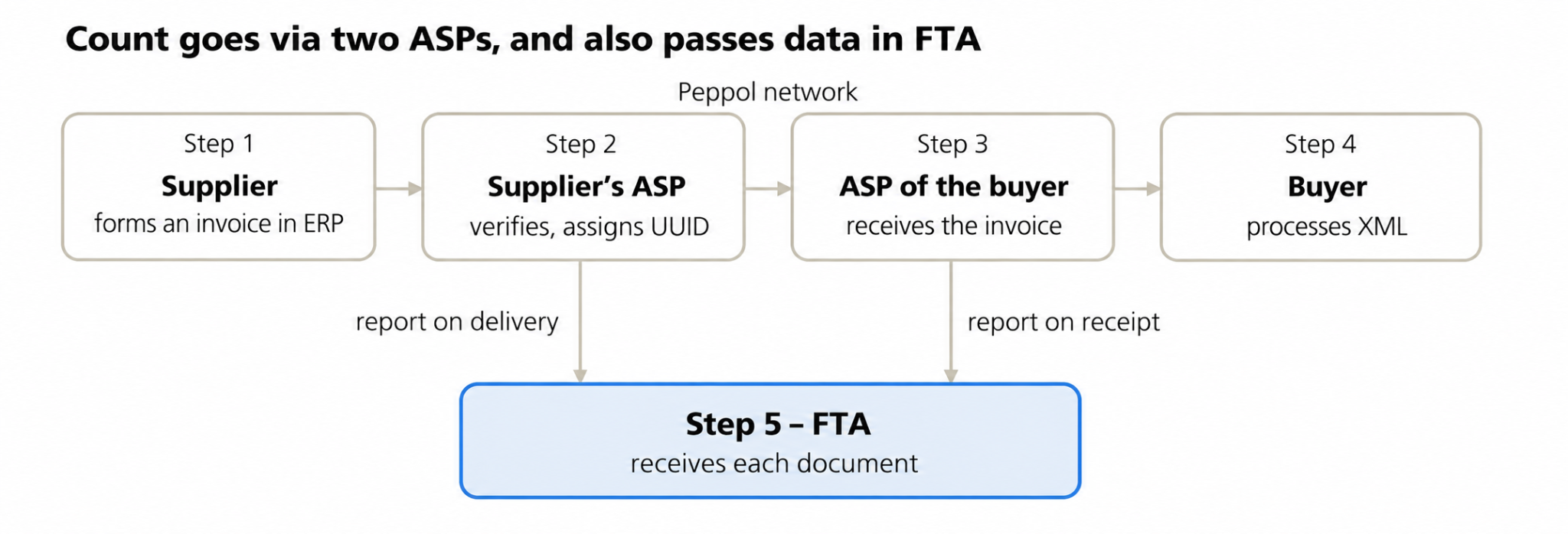
Five-corner model · Invoice flow and reporting in FTA
The invoice flows from left to right through the two ASPs, and the FTA receives data directly from both parties—so discrepancies between the supplier and the buyer are immediately apparent.
What this means in practice:
• No one other than the ASPs connects directly to the FTA. There is no government portal for issuing invoices, as in Saudi Arabia or India.
• This is not a pre-approval (clearance) model. The FTA does not approve the invoice before it is sent, and the buyer does not “accept” it. An invoice that has been verified by the ASP and delivered is considered issued.
• Invoices cannot be rejected within the system. Errors can only be corrected via a supplier credit note.
• Each document has a UUID assigned by the ASP. The invoice number remains the supplier’s internal number. A QR code is not required.
• The FTA sees transactions in near real time from both sides. Discrepancies between invoices and the VAT return are visible before the return is filed.
Timelines and Stages
|
Who |
Appoint an ASP by |
Switch to e-invoicing |
|
Pilot and Voluntary Transition |
— |
Effective July 1, 2026 |
Source: MD 244/2025, as amended by MD 66/2026, Articles 3–5; deadline for VAT groups—MD 243/2025, Article 4(1)(f).
How to Calculate the AED 50 million Threshold
• Revenue — gross revenue for the most recent reporting period as shown in the financial statements. If financial statements are not available, other documents acceptable to the FTA may be used. This is not the turnover subject to VAT.
• The period is not tied to the calendar year. If the fiscal year coincides with the calendar year, it is typically the year ending December 31, 2025.
• Scope—each legal entity is assessed separately based on its own financial statements, rather than as part of a group. Companies within the same group may be at different stages of the process.
• Composition—all revenue reported in the financial statements, including B2C, exports, and interest income.
New Companies
According to Guidelines V 2.0 (paragraph 8.4), a company established within the scope must appoint an ASP and complete the onboarding process before issuing its first invoice, regardless of its date of establishment; all of its invoices must be e-invoices. The Guidelines do not explicitly state how this relates to the MD 244 stages for companies established before July 1, 2027—this should be clarified with the FTA.
The 2027 Transition Period
From January through June 2027, it will be common for a supplier to already be connected while the buyer is not yet connected:
• The Phase 1 supplier sends the XML invoice to the service address 0235:9900000098—the data is transmitted to the FTA;
• At the same time, the buyer receives a standard invoice in PDF or on paper—this is needed for VAT deduction and tracking accounts receivable;
• Until July 1, 2027, the second-stage supplier issues standard invoices, and the first-stage buyer cannot refuse to accept them;
• Starting July 1, 2027, a PDF from a supplier within the system will no longer replace an e-invoice. The exception is government agencies until October 1, 2027.
Scope of Obligated Parties
Who Is Required to Comply
• Companies registered for VAT—must issue tax invoices in the form of e-invoices.
• Companies not registered for VAT (for example, those registered only for corporate income tax) — register using their TIN and issue commercial invoices (480).
• Freelancers and sole proprietors (sole establishment) providing services to companies fall under B2B. If they do not have a TIN, they must first obtain one through EmaraTax.
• Non-residents registered for VAT in the UAE issue tax invoices in the form of e-invoices.
• Recipients. The buyer also has obligations: they process incoming e-invoices through the system, which means they must also designate an ASP. This applies even to companies whose sales are entirely exempt but who have suppliers in the UAE.
• The counterparty’s status is irrelevant. Whether the buyer is connected to the system or registered for tax purposes does not affect the supplier’s obligations (Guidelines V 2.0, paragraph 6.1).
• Investment holding companies. A holding company that generates only passive income and has no business transactions is outside the scope. However, the reallocation of expenses (e.g., administrative expenses) constitutes a business transaction, and in that case, the holding company must be connected according to the general schedule (Guidelines V.2.0, paragraph 6.3.1).
• A safety net. An entity that works exclusively with individuals (B2C) is not subject to the system (MD 244, Art. 5(2)). However, if it has business suppliers in the UAE, an ASP is still advisable for receiving their invoices and safeguarding VAT deductions.
Regulatory Authorities
The UAE Ministry of Finance (MoF) develops the rules governing the operation of the e-invoicing system and publishes technical documents, including the UAE E-Invoicing Guidelines, Mandatory Fields and PINT AE. The Federal Tax Authority (FTA) receives information about submitted invoices from the supplier’s ASP and the recipient’s ASP, and administers the system’s requirements and related tax obligations. Accredited Service Providers (ASPs) are not government agencies but mandatory participants in the infrastructure: they verify and transmit invoices via Peppol, report to the FTA, and ensure the receipt of documents.
Accreditation, Selection, and Connection of ASPs
Requirements for ASPs under MD 168/2026
• An active, certified Peppol provider that has passed OpenPeppol tests.
• The product has been in operation for at least two years (a third-party product is acceptable).
• Paid-in capital of at least AED 50,000, audited financial statements, and ISO 22301 and ISO 27001 certifications.
• Insurance: professional liability coverage of at least AED 2.5 million; coverage for crime and cyber fraud of AED 5 million each.
• 100 free exchange and reporting transactions per year for each client—an ASP commitment specified in the accreditation declaration.
• Accreditation is valid for two years. If an ASP fails to renew it on time, the accreditation will be revoked and all client relationships will be terminated. Upon termination of accreditation, the ASP must notify clients within 5 business days.
• Providers with preliminary approval under the old MD 64/2025 must comply with the new requirements within 30 days starting October 1, 2026; otherwise, their approval will be revoked.
How to Choose
1. Create a shortlist of 3–5 providers from the official list on the Ministry of Finance and FTA websites. Check the accreditation expiration date.
2. Request a demonstration of the portal and its integration with your ERP—this is where the main issues tend to surface.
3. Evaluate providers based on the criteria (below) and compare prices on an equal footing.
4. Finalize the contract.
5. Complete the setup in EmaraTax and obtain a Peppol ID.
|
Criterion |
What to Check |
|
Integration |
A ready-to-use connector to your ERP or a documented API with a test environment; does the ASP accept your data and convert it to PINT AE on its own? |
What to Include in the Contract
• Availability levels, incident response times, and compensation;
• Data rights remain with the customer; the ability to export the archive and switch to another ASP without data loss;
• Notification of accreditation renewal and termination, migration plan;
• 100 free transactions per year;
• procedures for handling system failures, logs, and assistance with FTA relations;
• Allocation of liability for validation errors and transmission delays. The FTA will impose a penalty on the company, and compensation from the ASP is possible only under the terms of the contract.
Setup in EmaraTax
1. Select an ASP from the list and sign a contract.
2. The company’s account administrator logs into EmaraTax and selects the E-INVOICING tile.
3. Select an ASP and click “Proceed to ASP.”
4. On the ASP portal, the verification, account setup, and technical connection are completed.
5. The ASP provides the company’s Peppol ID.
If there is no TIN, it must first be obtained through EmaraTax. After any change to the company’s data in the FTA (name, address, etc.), the ASP must be notified in writing within 5 business days after the FTA confirms the change (MD 243, Art. 5(3)). A change of name does not alter the TIN and does not prevent the assignment of an ASP.
Before connecting, verify that the company’s information in EmaraTax is up to date: license, address, and contact details. Subsequent changes—such as VAT registration or deregistration, joining or leaving a VAT group, or closing the business—are reflected through re-verification or offboarding in EmaraTax (Guidelines V 2.0, paragraphs 13.5 and 15.3).
Changing ASPs and the Role of Partners
• You can change ASPs as often as needed by deactivating the old provider (offboarding) and activating a new one in EmaraTax. A legal entity may have only one ASP at a time
• The Peppol ID is linked to the TIN and is transferred to the new provider. Plan the transition in advance to ensure seamless service and access to the archive.
• An implementation partner can integrate an ERP system with an ASP but cannot replace the ASP unless the partner is accredited itself.
Legal Framework
The system is regulated at four levels: Federal Decree-Law No. 8 of 2017 On Value-Added Tax and its Implementing Regulations (Cabinet Decision No. 52 of 2017); Ministerial Decision No. 243 of 2025 (rules and exemptions) and Ministerial Decision No. 244 of 2025 (deadlines); Cabinet Decision No. 173 of 2026 (penalties); and technical guidelines from the Ministry of Finance. The legal force of regulatory acts and methodological specifications varies. The current versions and status of each document are listed at the end of this overview.
Transactions Within the Scope and Exceptions
Excluded Transactions (MD 243, Art. 4)
|
Exclusion |
Conditions and Limits |
|
Transactions by Government Agencies Acting in Their Sovereign Capacity |
Only if they do not compete with the private sector |
What does not require an e-invoice because it is not a supply or is not from our supplier
• Imports of goods and services from foreign suppliers. Their invoices are received as before, and VAT is accounted for using the reverse charge mechanism.
• Dividends, fines, deposits, and intra-group cash transfers—these do not constitute a supply.
• True disbursements—expenses paid on behalf of a client and re-invoiced without a markup, provided the conditions of Article 33 of the VAT Implementing Regulations are met. Re-invoicing of expenses (recharges) constitutes a supply and falls within the scope of the regulation.
• Pro forma invoices, commercial offers, reconciliation statements, and payment requests are not invoices. However, if payment is received based on them, an e-invoice is required for the amount received.
• Transactions conducted entirely outside the UAE between non-residents who do not conduct business in the UAE.
Types of Electronic Documents and Codes
Document Types
|
Code |
Document |
When to Use |
|
380 |
Tax Invoice (Electronic Tax Invoice) |
The supplier is registered for VAT; the supply is subject to VAT: standard and zero rates, exempt supplies (categories S, Z, E), including advance payments. Taxable and non-taxable lines can be combined in a single invoice |
Selection Rules:
• A credit note is always of the same type as the original document: for 380—381, for 480—81, for 389—261.
• There are no debit notes: an increase in the amount is processed via a new invoice.
• There is no separate type for a provisional invoice: each such invoice is issued as an e-invoice, and any adjustment to the amount is processed via a credit note or a supplementary invoice (Guidelines V 2.0, paragraph 10.1).
• The choice between 380 and 480 is determined by the tax regime, not just the supplier’s registration status. A tax invoice may include both taxable and non-taxable supplies; a separate document is not required (paragraph 10.2.2). However, in paragraph 10.2.1 of the same Guidelines, exempt supplies are still listed as an example of a commercial invoice, and the previous PINT AE validation rules allowed lines E, O, and Z in the 480 field. Until the specification is updated, verify the mapping with the ASP.
Transaction Type Code: Eight Flags
The Invoice Transaction Type Code (field BTAE-02) is a string of eight characters consisting of 0s and 1s. The order of the digits is fixed, and the flags are combined. A standard supply with no special features is 00000000. Each flag includes additional required fields.
|
Position |
Flag |
When Set |
Code |
For 480 |
|
1 |
Free Zone |
At least one party or beneficiary is located in a free zone |
10000000 |
Yes |
VAT Categories
The category is specified on each line and summarized in the document’s tax breakdown.
|
Code |
Category |
Typical Cases |
Additional |
|
S |
Standard rate: 5% |
Most supplies |
— |
Reason codes for exemption in the PINT AE reference guide: financial services, residential real estate (rental or sale), undeveloped land, local passenger transportation (codes DL8.46.1–DL8.46.4). The Guidelines provide a separate procedure for the margin scheme: the reported VAT amount is zero, and VAT on the margin is reported on the tax return; in Guidelines V 2.0, the margin scheme is designated as a separate, sixth tax category (paragraph 10.5); please verify its code against the current version of the specification.
Reason codes for credit notes
• the supply was canceled;
• the tax regime has changed due to a change in the nature of the supply;
• the agreed-upon consideration has changed (including a bad debt);
• return of goods or services with a refund of the consideration;
• VAT or the tax treatment was applied incorrectly;
• a volume discount (in this case, a reference to a specific original invoice is not required).
Participant identifiers: TRN, TIN, Peppol ID
Separate company, VAT group, branches
• Separate company: one TRN, one TIN, one address, one connection.
• VAT group: one TRN for the entire group, but each participant has its own TIN and address. Each participant connects separately and can choose its own ASP. The invoice specifies the group’s TRN and the participant’s TIN. A group of 30 companies requires 30 connections.
• Multiple licenses or branches of a single legal entity: one connection and one ASP. The invoice lists the legal entity’s registered name in the “Purchaser” field, and the branch is listed in the additional fields (trade name, contact, shipping address).
• A company not registered for VAT: It has a TIN but no VAT TRN. For companies registered for corporate income tax, the TIN consists of the first 10 digits of the number from the certificate. For those not registered anywhere, the TIN is first obtained through EmaraTax.
• Seller field in XML. A VAT-registered seller must provide the 15-digit VAT TRN (IBT-031). A seller not registered for VAT must provide a 10-digit TIN (IBT-032), including if they are registered only for corporate income tax. The corporate income tax TRN is not included in IBT-031 (Guidelines V 2.0, paragraph 18.1.1).
• Different TINs in the VAT and corporate income tax profiles. Mandatory Fields V 1.1 defines the TIN as the first 10 digits of the corporate income tax TRN. If a single legal entity has different TINs in its VAT and corporate income tax profiles in EmaraTax, the Guidelines recommend seeking a paid clarification from the FTA or a tax advisor (paragraph 18.1.2). This must be clarified before onboarding: the Peppol ID depends on the TIN.
• Foreign counterparty: neither a TRN nor a TIN is available. Enter the counterparty’s registration number in its home country and the country itself (see the paragraph on exports).
You can verify the TRN and TIN using the verification service on the FTA website.
Service addresses for special cases
|
Address |
When to use |
What happens to the document |
|
0235:9900000097 |
Deemed supply: no specific recipient |
Data is only transmitted to the FTA |
According to the Guidelines’ responsibility matrix, it is the supplier’s responsibility to collect buyers’ Peppol IDs.
The service address cannot be selected independently of the scenario: it is determined by a combination of the transaction type code and the buyer’s status (Guidelines V 2.0, paragraph 18.3.3).
Requirements for the invoice structure and mandatory fields
Groups of required fields in a tax invoice
|
Fields |
Group |
Composition |
|
1–9 |
Invoice Details |
Document number, date, type, currency, transaction type code, due date, and payment method |
How does a commercial invoice (480) differ from a tax invoice (380)?
|
Element |
Tax Invoice |
Commercial Invoice |
|
Seller Identifier |
TRN |
TIN, if no TRN |
Currency and exchange rate
• An invoice may be issued in any currency, but the VAT line item, line item amount, and total amount including VAT must also...