Dubai Anchorage Regulations "Manual" STS LNG Bunkering Regulations
Status
Issuing Authority
PCFC-Entity (Business Unit) Name: Dubai Maritime Authority
Department Name: Policy, Regulations & Technical Standards
Document Reference Number: PCFC-DMA-PRTS-REG-01
Revision Number: 00
Issue Date: January 2023
Classification: Public
1. Definitions
| 1.1. | AIS | : | Automatic Identification system |
| 1.2. | BS EN | : | British Standard European Norm |
2. Overall Regulations
2.1. Preface & Scope
This document outlines general rules governing STS LNG Bunkering Operations and provide guidance to personnel involved in such operations and working within DAA.
The objective of these instructions is to help on eliminating or reducing risks during marine operations and dovetail safety culture.
This guidance cannot and does not replace:
- Any International Convention, national law, regulation, guideline or statutory instrument, e.g. SOLAS, MARPOL, IMO resolutions and circulars,
- Any manufacturer's instruction and/or advice in the operation and/or maintenance of machinery, equipment or technical systems
- The Master's decision, made at the time. Each situation is different and requires a sound, pragmatic and professional approach by the Master
Only DMA Approved Bunker Suppliers are permitted to carry out LNG bunkering operation at DAA.
After registration, bunker suppliers are urged to renew their approval on an annual basis.
All bunkering operations must be approved by DMA at PCFC.
These Regulations and Rules do not overrule any Applicable International Requirements, Notice to Mariners or other instructions that may be issued by The Maritime Authority. The DMA can order the STS BUNKERING operation to stop at any time if it is believed that there is a risk of pollution or if the weather forecast is to deteriorate to unsafe operational levels.
Masters of vessels/ Persons In-Charge of LNG Bunkering Operations; are to be guided by the latest Applicable International Requirements, SIGTTO/CDI/ICS/OCIMF STS Transfer Guide and Port Byelaws and Regulations, as well as General Directions for Navigation. The objective of this document is to ensure that all STS bunkering transfers are conducted in accordance with Applicable International Requirements, Anchorage Regulations and OCIMF STS GUIDE, SIGTTO guidelines in a consistently safe and efficient manner.
2.2. Bunker Notification
Bunkering requests shall be applied online or request Form shall be sent by the Bunker Supplier/Agent to DMA, minimum of 24 hrs. prior to bunkering operations via E-mail when the bunkering is to be carried out within the DAA.
Bunkering request Form shall be sent to: PCFC Bunkering [email protected]
2.3. Control of Operations
The Master or other person in overall charge of the operations should be agreed and clearly established prior to the start of operations.
The actual bunkering transfer operations should be carried out in accordance with the requirements of the latest Applicable International Requirements.
2.4. Manning and Duration of Operations
Each Master should take into consideration the estimated duration and the particular requirements of the operations to ensure that adequate manning requirements can be maintained throughout the operations
2.5. Emergency Signal
A series of short rapid blasts on the ship's whistle or siren to be sounded by either ship in any emergency during the transfer operations.
Emergency signals during approach or departure maneuvers should be the signals prescribed by the International Regulations for Preventing Collisions at Sea.
2.6. Emergency Response Plan
For the purpose of this Regulation an emergency plan is a plan agreed between both ships before the operations commence, allocating specific duties for all ship's personnel in an emergency affecting bunkering operations.
2.7. Communications
2.1.1. Satisfactory Communications
Satisfactory communications between the ships are an essential requirement for successful bunkering operations.
2.1.2. Language
A common language or operational vocabulary to be used in communications should be agreed, before the operations commence, to avoid misunderstanding. In this connection, attention is drawn to the Standard Marine Navigational Vocabulary, using the English language, published by the Inter-Governmental Maritime Consultative Organization (IMCO).
2.1.3. Initial Contact
The ships should establish initial contact by radio as soon as practicable to plan the bunkering operations.
2.1.4. Communications during Approach. Mooring and Unmooring
Radio telephone contact should be established on VHF Channel 16 at the earliest opportunity, thereafter switching to a mutually agreed working channel. Approach, mooring and unmooring should not be attempted until fully effective communications are established. Officers responsible for mooring stations should be provided with intrinsically safe portable hand-held transceivers.
2.1.5. Communications during Bunkering Operations
Essential personnel on both ships involved in the transfer operations should at all times have reliable means of communications such as intrinsically safe portable hand-held transceivers.
2.1.6. Breakdown of Communications.
A total breakdown of communications on either ship while she is maneuvering should be indicated immediately.
The approach operations should be suspended and the action taken to abort the maneuvers should be indicated by the proper sound signals prescribed by the International Regulations for Preventing Collisions at Sea.
Should a similar failure occur during the transfer of liquefied gas the operation should be suspended. Operations should not be resumed until full communications have been re-established.
2.1.7. Radio Transmissions
The ignition of gas vapors may be possible by direct or induced radio frequency energy and no radio transmissions, other than at very high frequencies, should take place during Bunkering operations. Arrangements should be made with an appropriate coast station prior to the Bunkering operations for blind transmissions which would allow reception of urgent messages by the vessels where appropriate.
2.8. Underway Mooring and Unmooring Not Allowed
Mooring and unmooring on one ship while the other maintains steerage is not allowed.
2.9. Compliance
In order to comply with internationally recognized guidelines, this manual shall be read in conjunction with the Latest Applicable International Requirements, OCIMF GUIDE and the SIGTTO guidelines as well as the Operating Regulations for the DMA.
2.10. Document Control
This STS Bunkering manual is a live document and will be reviewed in a regular basis in the light of operational experience and regulatory environment. The latest revision will always be available on https://DMA.ae/ar/InformationCenter/Regulations.aspx
3. Conditions and Requirements
3.1. Approval from DMA
The local Agent or bunkering provider shall keep DMA advised of the ETA's of ships' likely to be performing Bunkering. An updated and confirmed ETA shall be sent 24 (twenty-four) hours prior arrival to the anchorage. The local Agent or bunkering provider shall submit Pre-Arrival Questionnaire for VESSELS calling for BUNEKRING operation. This questionnaire to be completed fully and truthfully, as well as signed and stamped by the masters. Approval for an STS Bunkering will be given by the DMA after careful assessment of the vessels involved, weather forecasts for planned duration of operation, congestion in DAA, other operations etc.
3.2. Obligation and Distribution of Responsibility
The Master and Crew shall be responsible at all times for the safety of the vessel and shall make provision to exercise prudent seamanship and all necessary precautions to maintain the integrity and efficiency of all the systems with which the vessel is provided.
In all cases each Master remains responsible for the safety of his own ship, its crew, cargo and equipment, and shall not permit their safety to be prejudiced by the actions of the other Master, his owner, regulatory officials or others.
Responsibility for the safe conduct of operations while a ship is receiving bunker by other ship, is shared jointly between the master of the receiving vessel, the bunker vessel.
All parties remain responsible for shutting down the operation in order to prevent incidents and accidents irrespective of the cause of any arising problem.
The master of the vessel is responsible for all operations controlled and supervised from the vessel, the master of the bunker vessel is responsible for all operations controlled and supervised from the bunker vessel.
3.3. Ship to Ship Compatibility
Each master of the vessels is planning to engage in a ship to ship (STS) Bunkering operation shall ensure that his vessel is compatible in design and equipment to conduct STS Bunkering. A compatibility assessment should be undertaken to confirm the suitability of the vessels for the planned operation and to identify any aspects that may require particular management.
STS compatibility assessments should include, but not limited to, the questionnaire in Appendix L in Ship to Ship Transfer Guide for Petroleum, Chemicals and Liquefied Gases, developed by SIGTTO/CDI/ICS/OCIMF.
3.4. Transfer Area
STS Bunkering will take place at Anchorage Designated Area that shall be determined by DMA Offshore Services", which can accommodate one STS operation.
3.5. Environmental Conditions
When weather forecasts predict mean wind speeds above 20 knots or swell of 1.85m or more, the DMA will decide regarding stoppage of the STS transfer operations at the anchorage area. This decision considers predicted wind speed and direction, moorings, ship sizes, availability of tugs etc.
However, this does not relieve ship masters involved in STS Bunkering Operations from their duties and responsibilities to exercise prudent seamanship and take early decision regarding the stoppage of bunkering operation and unmooring of the vessel if need be.
At continuous wind speeds above 20 knots or swell height of 1.85m or more, the following shall be done:
- All STS mooring will be suspended
- All Bunkering operations must be suspended
At continuous wind speeds above 25 knots or swell height of 2.75m or more, the following shall be done:
- All Bunkering transfer and vapor return hoses must be drained, purged and disconnected
- The double banked vessels must be unmoored.
Safety factors that should be considered by the Masters are as follows:
- The movement of the two ships
- The behaviour and integrity of the fenders, vessel mooring failure and failure of one or more mooring between the vessels.
- Weather forecast including, but not limited to:
- Visibility
- Wind speed and direction
- Wave and swell height, period and direction
- Due regard is to be paid to weather forecasts and early action taken to suspend transfers, if safe to do so, when severe weather is imminent.
Experience indicates that STS Bunkering Operations in locations subject to long period waves should be treated with caution. It should be expected that mooring loads will increase with wave period or as the period of wave encounter increases.
The combined effect of current and weather conditions on the yawing movements of the anchored vessel and the ultimate tension on the anchor cable should be considered.
Factors for at sea operations also include the physical sizes of the ships and their maneuvering capabilities, the speed of the approaching weather, free surface effect and sloshing limitations. In relatively heavy seas, the agitation of the cargo can increase tank pressures to unusually high levels during the STS transfer.
3.6. The LNG Bunkering Supply Ship & Class Notations
The LNG Bunkering Supply Ship (Ships having the function of bunkering LNG fuel) shall be built according to IGC code and must be complying with all international applicable requirements and be classed with IACS Classification Society approved by UAE, accordingly the LNG Bunkering Supply Ship shall be assigned additional class notation of LNG Bunkering.
3.7. The LNG Fuelled Ship (Receiving Ship) & Class Notations
The LNG Fueled Ship (Ships having the function of receiving the LNG as a fuel from the bunkering Supply Ship) must fully comply with the IGF code and also have a safe bunkering procedure, which is carried out according to the approved ISM manual onboard.
She should comply with the standard ISO 20519:2017 or similar. She must be complying with all international applicable requirements and be classed with IACS Classification Society approved by UAE, accordingly the LNG Fueled Ship shall be assigned additional class notation of LNG fuel.
3.8. Emergency Towing-off Pennants
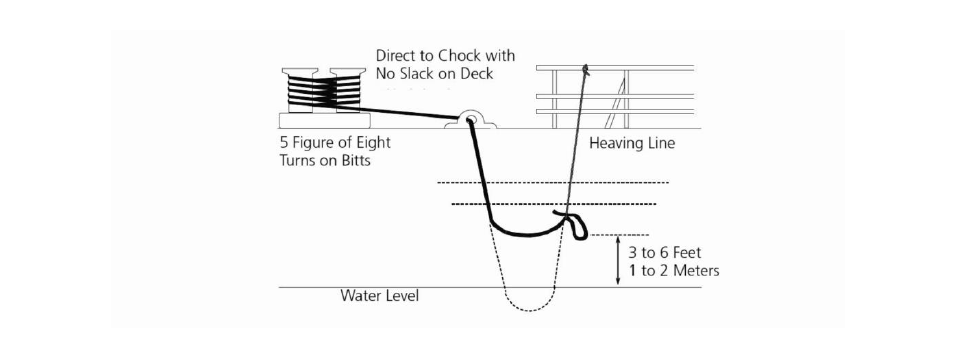
Emergency towing wires (fire wires) are required to be Correctly Rigged and Positioned, and shall be made fast to bitts as far forward and as far AFT as practicable on the side of the vessel opposite to the cargo connections.
The wires shall be in good condition and secured with a minimum of five figure of eight turns on the bitts.
The wire shall lead directly to the chock with no slack on deck and a heaving line made fast to the eye shall be used to maintain the eye of the wire between one and two meters above the water at all times, see diagram below. The wires shall be regularly checked and adjusted.
3.9. Prevention of Fatigue
Human error from fatigue is perceived to have contributed to a number of marine casualties.
Ships' crews and STS must follow the guidelines as per the relevant ILO, IMO and national regulations when planning hours of work. In this respect, it is the duty of the Master to plan rest periods accordingly, requesting additional staff when necessary.
3.10. Smoking and Naked Lights
Regulations regarding smoking and the use of naked lights should be strictly enforced by the respective Masters. Warning notices should be displayed and smoking rooms should be designated and clearly marked.
Due consideration should be given to the different sizes and configurations of vessels, particularly with regard to risks associated with the accommodation spaces of one vessel infringing on the flammable zone of another vessel.
3.11. Earths on Electrical Switchboards
If earth indicator lights are showing on the main switchboard, faults must be traced and isolated. This is to avoid the risk of arcing, especially in deck areas where gases accumulations may be present.
3.12. Soot blowing
It is forbidden to blow tubes in DAA and during STS transfer. Moreover, Exhaust uptakes should be regularly monitored. In case of sparking from the funnel, Bunkering operations should be stopped immediately.
3.13. Incinerators
Incinerators should not be used during STS bunkering operations.
3.14. The Use of Radar, Radio and Satellite Communication Equipment
The ships main radio transmitting aerials on both ships shall be earthed and neither ship shall use this equipment whilst alongside one another. Mobile telephones and non-intrinsically safe electrical items must not be used, or carried when switched on, on the bunker station deck.
Satellite communications present no safety hazard, but must not be used if flammable gas accumulates near the antenna.
AIS equipment is considered safe and should be kept operational for the purposes of port control. However, the Very High Frequency (VHF) equipment used for the AIS broadcasts must be set to low power output during STS bunkering operations.
The use of radar involves the operation of electrical equipment, such as scanner motors, not suited for operation in a potentially hazardous area. Therefore, the radars must be switched off prior to berthing and while alongside.
3.15. Electrical Storms
When an electrical storm is present or imminent in the bunkering transfer area, the bunkering transfer operation must be suspended and all vent risers, cargo system and Inert Gas Systems (IGS) secured until such time as it is considered safe to resume operations.
3.16. Galley Stoves
Before permitting the use of galley stoves and other cooking appliances while a vessel is engaged in STS operations, Master must ensure that such appliances are safe and that no danger exists.
3.17. Accommodation Openings
All access doors to the accommodation, especially those opening directly on to the bunker station deck, should be kept closed during bunker transfer operations. The Master of each ship should designate those access doors that are to be used for personnel transit. Such doors, if used for personnel transit, must be closed immediately after use. Air conditioning units should be set on circulation in order to avoid the inadvertent intake of gaseous vapors. However, air conditioning must not be set to 100% recirculation, as this will cause the pressure of the internal atmosphere to fall to less than that of the external atmosphere, due to the extraction fans operating in sanitary spaces and galleys. If at any time it is suspected that gas is being drawn into the accommodation, central air conditioning and mechanical ventilation systems should be stopped and the intakes covered or closed.
3.18. Material Safety Data Sheets.
Both vessels must have copies of the Material Safety Data Sheets (MSDS) for the products being transferred. Where bunker vapors and residues are present in the receiving vessel's tanks, a copy of the previous bunker should be provided to the bunker supplying vessel. This will enable the bunker supplying ship's personnel to take suitable precautions in the event that the previous bunker contained toxic vapors that could be displaced onto the deck of the bunker supply ship or returned to the ship's tanks through vapor balancing or vapor return. Particular attention must be given to the potential of toxic substances in the vapors and all necessary personal safety precautions must be taken. Only MSDS issued by the shipper is acceptable and other generic MSDS must not be used for LNG bunkers.
3.19. Readiness of Firefighting Equipment
Firefighting equipment including fixed dry powder system shall be maintained on station ready for immediate use on all vessels involved in STS operations. Additional portable fire extinguishers, suitable for the product being transferred, should be placed in the manifold area. Fire monitors must be pointed towards the manifold in use and left in a suitable condition for hands-off operation.
3.20. Fenders and Bunker Hoses
The master of the vessel being maneuvered alongside should be able to call upon experience when assessing fender requirements, in terms of size and number, for STS mooring and must ensure that fenders used are suitable in terms of energy absorption and result in sufficient stand-off distance such that the compressed diameter of the fenders is always sufficient to ensure that there can be no contact between ships structures through rolling during the period alongside, particularly between vessels that have relatively high freeboards.
The International Standard (ISO 17357-1:2014 and ISO 17357-2:2014) specifies the material, performance and dimensions of floating pneumatic fenders which are intended to be used...