Chairman of the Board of Directors Decision No. 53 of 2014 Regarding the Adoption of Regulations Governing the Conversion of Vehicles to Natural Gas
Status
Issuing Authority
Effective date
Chairman of the Board of Directors:
- Having reviewed Federal Decree-Law No. 28 of 2001 establishing the Emirates Authority for Standardisation and Metrology, as amended,
- Board of Directors Decision at its meeting No. 3/2014 held on July 3, 2014 to approve the regulations governing the conversion of vehicles to natural gas
has decided the following:
Article 1
The Regulations on the procedures for converting vehicles to natural gas, annexed to this Decision, are hereby adopted.
Article 2
This Decision shall be communicated to the relevant authorities and published, together with the aforementioned regulations, in the Official Gazette; it shall be published and come into force on the day following the date of publication.
Dr Rashid Ahmed bin Fahd
Minister for the Environment and Water
Chairman of the Board of Directors of the Emirates Authority for Standardisation and Metrology
Issued in Dubai: Date: July 15, 2014
UAE Regulation of Natural Gas Driven Vehicles (NGVs)
Foreword
Emirates Authority for Standardization & Metrology (ESMA) has a national responsibility for standardization activities. One of ESMA main functions is to issue UAE Standards and regulations through specialized technical committees and working Groups.
ESMA through established Specialize Technical Working in cooperation with AD-NOC Distribution had prepared the draft of this UAE regulation of Gas Driven Vehicles (Vehicle Conversion into natural gas in UAE as well as OEM NGVs) and circulated to all Executers of this project in UAE for comments.
The final Draft of this UAE Regulation has been approved by ESMA Board of Directors in its third meeting 2014 and issued by His Excellency the President of the Board of Directors, decree no. 53 of year 2014. The approved Regulation will replace and supersede the UAE.S 5007 "Guideline for equipment, testing and operation of vehicles propelled by Compressed Natural Gas".
Part 1 - General Information
1. Related Laws and Legal Requirements
| National Laws, Decrees, Regulations and any other Legal requirements | |
| National Laws and Decrees |
2. Definitions and Abbreviations
2.1. Definitions
GST: Is conducted periodically and at special events (accident, fire, repair) Test of the CNG system on all NGVs.
PTI: Is a periodical visual inspection of the CNG system
GSIT: Is the first inspection of CNG system after installation
Stakeholder: Is a person, group, organization, or system that affects or can be affected by an organization's actions.
2.2. Abbreviations
ESMA Emirates Authority for Standardization and Metrology
ADNOC Abu Dhabi National Oil Company
ADNOC DIST. ADNOC Distribution
ENOC Emirates National Oil Company
EMGAS Emirates GAS – ENOC Group
SEWA Sharjah Electricity & Water Authority
ENAS Emirates National Accreditation Service
ECAS Emirates Conformity Assessment System
(UN)ECE United Nations Economic Commissioner for Europe
NGV Natural Gas Vehicle
OEM Original Equipment Manufacturer
CNG Compressed Natural Gas
DF Dual Fuel
CoC Certificate of Conformity
GST Gas System Test
GSIT Gas System Installation Test
PTI Periodical Technical Inspection
RVW Road Vehicle Workshop
QAM Quality Assurance Manager
TPI Third Party Inspection Body, accredited by ENAS
irt In relation to
3. Purpose
The purpose of this Regulation is to establish and operate a scheme regulating vehicle conversion into natural gas as well as OEM NGVs in the UAE.
4. Scope
The scope of this regulation comprises the following areas:
- Legal criteria for the use of natural gas components and their installation into vehicles
- Stakeholders and their roles
- Certification of NGV RVW
- Approval of converted vehicles and OEM vehicles using Compressed Natural Gas (CNG) in their propulsion system
- Training and certification of the NGV specialists and the responsible persons
- Inspections and certification of NGVs
- RVW requirements (safety, operation and certification)
- Labeling and marking
- Cylinder re-inspection Requirements
5. Technical Requirements
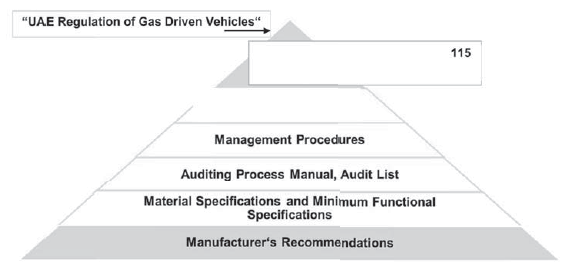
Figure 1: Hierarchy of Requirements

Figure 2: NGV implementation flow chart
6. The Executer & Regulatory body in the various UAE Emirates

7. ESMA Requirements
7.1. Certification and Inspection bodies
7.1.1 Certification and inspection bodies shall have a legal status and commercial and technical license according to the local regulations
7.1.2 Certification and inspection bodies shall be accredited according to the requirements of ENAS.
7.1.3 Certification and inspection bodies shall be registered with executor.
7.2. Conversion Centers and NGV Agency workshops
7.2.1 Conversion centers and NGV Agency workshops shall have a legal status and commercial and technical license according to the local regulations.
7.2.2 Conversion centers and NGV Agency workshops shall be certified according to the requirements of this regulation.
7.2.3 For the purpose of this Regulation, Conversion centers and NGV Agency workshops are called "Road Vehicle Workshops" (RVW).
7.2.4 Conversion centers and NGV Agency workshops shall be registered with executor
8. Stakeholders Tasks
8.1 Executer Tasks
8.1.1 Manage, control and develop the "CNG Business".
8.1.2 Cooperate with the concerned Authority in charge and as per Executive Council Decrees to provide and develop the business regulation.
8.1.3 Convert and maintain the vehicles which work by Compressed Natural gas as a fuel.
8.1.4 Design, construct and operate the compressed Natural gas filling station and Conversion Centers
8.2 ESMA Tasks
8.2.1 Maintain and update the UAE technical regulation No. UAE.S ECE R 110 & UAE.S ECE R 115 and any issued or adopted standard/regulation related to the Compressed Natural Gas business
8.2.2 Provide any required or necessary standard/regulation related to the Natural Gas business
8.2.3 ECAS certifies the special retrofit parts and conversion components.
8.3 ENAS Tasks
8.3.1 To accredit management system certification bodies according to the requirements of the standard UAE.S GSO ISO/IEC 17021.
8.3.2 To accredit Third Party Inspection bodies according to the requirements of the standard UAE.S GSO ISO/ IEC 17020
8.3.3 To accredit personnel of certification bodies according to the requirements of the standard UAE.S GSO ISO/IEC 17024
8.4 TPI Tasks
8.4.1 Inspection, auditing, and certification of Road Vehicle Workshops to convert vehicles to natural gas.
8.4.2 Training, examination, and certification of the gas conversion specialists and the responsible persons according to this regulation.
8.4.3 Review and approval of the CNG components and documents to make they comply with the applicable regulations
8.4.4 Final inspection, approval, and certification of vehicles subsequent to CNG conversion (GSIT).
8.4.5 Cylinder re-inspection and certification.
8.4.6 Periodical inspection of NGVs and inspection of NGVs after critical event (GST)
9. Fees
Any fees incurred by any of the stakeholders in the provision of implementing the gas conversion scheme shall be approved by the executor.
10. Training
Training is carried out according to the training scheme in this regulation.
11. Technical References

12. Specific restrictions
Used NGV
Imported used vehicles with CNG system onboard as well as any used CNG components taken from an imported used vehicle and single imported used components are not allowed /permitted to be utilized with natural gas as a fuel.
Authorized conversion centers/NGV dealer workshops
Only the authorized conversion centers and NGV dealer workshops which are nominated by the executor are permitted to work in CNG business and appropriate legal actions shall be taken against any unauthorized conversion center.
Material used for high pressure tubing in vehicle conversion
For high pressure tubing Stainless Steel 316L and CoC for CNG are mandatory.
UAE.S ECE R115
PART – I
This part of the regulation is Not Adopted and Accordingly "LPG" Is Not Allowed to Use as Motor Vehicles Fuel in UAE.
Part 2: Guidelines and Procedures
I. Pressurized gas systems and pressure vessels
1. Motor vehicles which are fitted with special equipment or components for use with compressed natural gas (CNG) in their drive system, must as a result of converting be approved in accordance with the provisions of the regulations stated in the Annex 1 of this regulation. Before the first vehicle registration the vehicle must be submitted to a final Executor/Executor nominated TPI acceptance to obtain a vehicle approval.
2. Special retrofit systems for using compressed natural gas (CNG) in the propulsion system of a road vehicle must after fitting be approved in compliance with the provisions of the regulations stated in the Annex 1 of this regulation. Before the first use of the retrofit system the vehicle must be submitted to a final Executor/Executor nominated TPI acceptance to obtain a vehicle approval
3. Special components for using compressed natural gas (CNG) in the propulsion system of a road vehicle must after fitting be approved in compliance with the provisions of the regulations stated in the Annex 1 of this regulation. Furthermore, for their installation, the conditions which are stated in the provisions of the regulations in the Annex 1 of this regulation must be complied with. Before the first use of these components the vehicle must be submitted to a final Executor/Executor nominated TPI acceptance to obtain a vehicle approval.
4. Manufacturers of motor vehicles to Paragraph 1 or retrofit systems to Paragraph 2 or special components to Paragraph 3 must include the required information documents corresponding to the requirements of the regulations stated in the Annex 1, for fitting and safe use during the intended service life and the recommended maintenance. These documents must be made available when required to the persons responsible for fitting, operating and testing.
5. Vehicle owners, whose motor vehicles have been fitted with equipment to Paragraph 2 or Paragraph 3, after installation must submit their vehicles to a gas system installation test (GSIT) in accordance with Appendix I. Gas system installation tests may only be carried out by:
a. Responsible persons of certified road vehicle workshops provided that the gas systems are installed at this road vehicle workshop
b. Governmentally authorized inspectors for road transport After the gas system installation test the owners of motor vehicles with equipment to Paragraphs 2 and 3 must submit their vehicles to final Executor/Executor nominated TPI acceptance to obtain a new vehicle approval.
6. Owners whose road vehicles are fitted with equipment to Paragraphs 1 to 3 must undergo a gas system test (GST) to Appendix I at least every one year, or immediately subsequent to any gas system repair. This also applies if the gas equipment is impaired by fire or accident. Gas system tests may only be carried out by:
a. Responsible persons of certified road vehicle workshops provided that gas systems are installed at this road vehicle workshop
b. Governmentally authorized inspectors for road transport
c. After the gas system test (GST) the owners of motor vehicles with equipment to Paragraphs 2 and 3 must submit their vehicles to final Executor/Executor nominated TPI acceptance.
7. The approval of road vehicle workshops for performing the gas system installation tests to Paragraph 5, the gas system tests to Paragraph 6 is described in Appendix II. The training of the nominated persons according Paragraph 5 Clause b and Paragraph 2 and 3 as well as Paragraph 6 Clause c and Paragraph 2 and 3 has to be carried out in line with the requirements of numbers 2.5, and 7.3 of Appendix II
8. Cylinders for using compressed natural gas (CNG) in the propulsion system of a road vehicle shall be re-inspected after 36 (36) months of use as follows based on ISO/19078 requirements :
a. External (visual) inspection by Executor/Executor nominated TPI
b. Internal (visual) inspection by Executor/Executor nominated TPI
c. Volumetric expansion test by Executor/Executor nominated TPI
Notwithstanding the provisions of I, Paragraph 8, c., the volumetric expansion test only applies for a number of 10% of randomly chosen cylinders out of the field, or if evidence is given which requires this test. It is with the Executor/Executor nominated TPI to decide.
II. Guidelines for carrying out gas system installation tests
(in the following abbreviated to GSIT) or the recurring or other gas system tests (in the following abbreviated to GST) GSIT/GST-Guidelines for carrying out tests).
1. General
1.1 The guidelines are valid for carrying out the GSIT to I Paragraph 5 and the GST to I Paragraph 6. GST to be made as a part of the annual vehicle re-inspection.
1.2 When carrying out the GSIT and the GST it is to be determined whether the condition and gas tightness of the tested vehicle are to the current state of the art and can be classified as 'satisfactory'. To do so valid manufacturer information for the vehicle and the subsequent detailed scope of the work to be carried out.
1.3 As evidence of the determined condition of the gas system and its equipment for the inspected vehicle, a certificate is to be issued by the responsible person corresponding to the requirements of Appendix I No 2.4. An example of the evidence is given in the Form 1 of these guidelines. The evidence is to be kept for 3 years.
1.4 When testing the tightness of the gas system the leak detector used must be in accordance with the manufacturer's directive.
2. Preparatory activities
2.1 Vehicle documentation to be presented.
2.2 Check that the documents presented belong to the vehicle concerned.
2.3 Determine for the examined vehicle which gas is used in order to ensure that the required equipment is available.
2.4 Ensure that the gas tank is at least (50%) full with fuel or filled to the manufacturer's requirements. If the quantity of gas is less than specified a further testing is not possible.
3. Carrying out the gas system test (GST)
3.1 Testing a gas (CNG) driven vehicle.
3.1.1 Identification of the components
By identifying the components it is ensured that any allowed and properly marked components were used. For this are included:
- Gas tank
- Pressure regulator
- Gas pipe material
- Safety relevant components, e.g. non-return valve, safety devices, receptacles, etc.
3.1.2 Visual inspection of components
All gas components are to undergo a visual inspection. During a visual inspection it is possible to check the condition (damage, corrosion., fixing) of the gas system without disassembly. To be carefully inspected
- Specified lifetime of the pressure gas container/s
- Receptacle
- Gas tank and fixation
- Tank armatures / valves
- Pressure relief device
- all gas conducting pipe work
- Gas vapor retaining systems
- Pressure regulator
- Injectors
- Warning lights / control lights.
3.1.3 Functional test
The function test includes:
- Main shut-off valve of each gas tank
- Fuel chance-over switch - if fitted
- Control device / start interruption
3.1.4 Leak test
A precondition for the leak test is that gas tank must be filled in compliance with number 2.4.
Set fuel change over switch to gas operation (only for bivalent operation) and start engine. With the engine running use the leak detector or the leak detection spray to carry out the leak test. During the test all screw connections, welded joints (if present), engine supply-pipes, valves and other relevant gas components are to be 'sniffed' with the leak detector or sprayed with the leak detection spray.
If installed, check also the high and low pressure components.
If when using the leak detector a gas emission is detected, then the leak detection spray is also to be used to localize the leaking connection or the peaking component. Possibly all un-tight connections and components are to be sprayed. The contact time period for the leak spray to become effective is at least 3 minutes. The gas system can be defined as leak free when within the effective period for the spray no bubbles are detected.
If it is not possible to undertake the test with the engine running, then the engine is to be run for at least 2 minutes under gas operation and after switching off the engine the leak test is to be carried out immediately.
The manufacturer's information for carrying out the test is to be observed.
3.2
Issue of the certificate to No 1.3.
4. Carrying out the gas system installation test (GSIT)
4.1 Allocation of retrofit equipment to vehicle's range of application
4.2 Allocation of workshop certification regarding the set-up and/or software version according to the provisions of the approval or the manufacturer
4.3 Installation inspection, e.g., installation of pipes/wires, labeling of pipes/wires, pipe/wiring connections, tank fixations, etc.
4.4 Functional test e.g. switching over from petrol to gas, shut-off valves etc..
4.5 Leak test of the system according to No 3.1.4
4.6 Issue of the certificate to No 1.3.
Form 1
in accordance with no. 1.3 of II "GSIT/GST-Guidelines for carrying out tests"
III Guidelines for the approval of road vehicle workshops
to undertake gas system installation tests (in the following abbreviated to GSIT) or the recurring or other gas system tests (in the following abbreviated to GST) to I irt App I and II (Gas workshop approval guidelines).
1. General
These guidelines are valid for road vehicle workshops (ir the following abbreviated to RVW), which carry out and certify GSIT or other GST as specified in I irt. Appendix I and therefore need to be approved to Appendix II No 1. The certification to carry out the GSIT is also valid to carry out the GST. Only GSIT certified workshops are entitled and allowed to convert vehicles to use compressed natural gas (CNG) in there propulsion system according to paragraph (1) through (3) of I.
2. Application
The application...