Cabinet Decision No. 159 of 2025 On the Adoption of a Classification Guide for Public Benefit Organizations and Public Benefit Activities Сonducted by Them
Status
Issuing Authority
Effective date
The Cabinet:
- Having reviewed the Constitution;
- Federal Law No. 1 of 1972 On the Competencies of the Ministries and Powers of the Ministers, as amended;
- Federal Decree-Law No. 2 of 2018 On Combating Money Laundering, Terrorist Financing and Proliferation Financing, and its amendments;
- Federal Decree-Law No. 50 of 2023 On the Regulation of Public Benefit Organizations;
- Cabinet Decision No. 5 of 2025 Concerning the Executive Regulations of Federal Decree-Law No. 50 of 2023 On the Regulation of Public Benefit Organizations;
- Based on the proposal of the Minister of Community Empowerment and the approval of the Cabinet,
has decided:
Article 1 - Approval of the Classification Guide
The Classification Guide for Public Benefit Organizations and Public Benefit Activities conducted by them attached to this decision is hereby approved.
Article 2 - Publication and Enforcement
This decision shall be published in the Official Gazette and come into force on the day following its publication.
Mohammed bin Rashid Al Maktoum
Prime Minister
Issued:
On 13 Jumada al-Awwal 1447 AH
Corresponding to November 4, 2025 AD
Classification Guide for Public Benefit Organizations and Public Benefit Activities Сonducted by them Approved by Cabinet Decision No. 159 of 2025 On the Adoption of a Classification Guide for Public Benefit Organizations and Public Benefit Activities Сonducted by Them
1. Introduction
As part of the efforts made by the State to empower Public Benefit Organizations to enhance their roles and responsibilities in supporting national development, a Guide has been prepared for classifying Public Benefit Organizations and the activities they carry out in accordance with the Public Benefit Activities and various fields of work specified in Federal Decree-Law No. 50 of 2023 regarding the regulation of Public Benefit Organizations, in light of the best international practices and standards applied in the non-profit sector, and in a manner commensurate with the nature and characteristics of these Organizations. The Guide specifies the controls, standards and requirements for classifying Public Benefit Organizations and the activities they carry out, thereby facilitating access to data and information on groups of Public Benefit Organizations that are similar in terms of activities and fields of work.
2. Objectives
The Guide aims to:
- Classify Public Benefit Organizations.
- Standardise the controls, procedures, conditions and requirements for classifying Public Benefit Organizations and the activities they conduct.
- Adopt a unified framework and organise practical Guidelines related to the Classification process and present them to the various concerned parties.
- Accurately define the areas and activities of Public Benefit Organizations.
- Facilitate access to data and information on groups of Public Benefit Organizations that are similar in terms of activities and areas of work.
3. Scope of application
The Guide is the reference document for the Competent Authority responsible for licensing, supervising and monitoring Public Benefit Organizations and applies to Public Benefit Organizations subject to the provisions of the Decree-Law.
4. Definitions
In the application of this Guide, the following words and phrases shall have the meanings indicated opposite them, unless the context of the text requires otherwise:
State: The United Arab Emirates.
Ministry: Ministry of Community Empowerment.
Minister: Minister of Community Empowerment.
Decree-Law: Federal Decree-Law No. 50 of 2023 Concerning the Regulation of Public Benefit Organizations.
Local Authority: The local government authority responsible for licensing, supervising and monitoring Public Benefit Organizations in accordance with its applicable legislation, within whose jurisdiction the headquarters of such Organizations or any of their branches are located in relation to the activities of that branch.
Competent Authority: The Local Authority or Ministry in the Emirate where there is no Local Authority competent to license, supervise and control Public Benefit Organizations.
Public Benefit Organizations: Private legal entities licensed in accordance with the laws in force in the State, established for the purpose of carrying out one or more Public Benefit Activities, and taking one of the forms stipulated in the Decree-Law and its implementing regulations, without primarily aiming to make a profit.
Public Benefit Activities: The areas of work of Public Benefit Organizations, including social, cultural, scientific, educational, professional, creative, artistic, recreational and environmental activities, the provision of humanitarian services, and the achievement of any of the purposes of charity or solidarity covered by the provisions of the Decree-Law.
Guide: Guide to the Classification of public benefit organisations and the Public Benefit Activities they carry out.
Classification: Description of Public Benefit Organizations within categories and groups that are similar in terms of activities and fields of work.
5. Roles and responsibilities
The Ministry works in coordination with the Local Authority to manage and monitor the Classification process for Public Benefit Organizations. To ensure the efficiency and effectiveness of the Classification, the roles, responsibilities and competencies of both the Ministry and the Local Authority in relation to the Classification process have been defined as follows:
First: Roles and responsibilities of the Ministry
The Ministry plays a key role in the process of classifying Public Benefit Organizations and their activities. The Ministry's tasks begin with setting the criteria, controls and requirements for determining the main and sub-Classifications of Public Benefit Organizations in coordination with the Local Authority. It is responsible for ensuring that local authorities comply with and implement these standards, controls and requirements by utilising its resources and strengthening its capabilities in all the processes covered in this Guide. Specifically, the Ministry is responsible for:
1. Establishing standards, controls and requirements for determining the main and sub-categories of Public Benefit Organizations.
2. Conducting a comprehensive and unified Classification process for Public Benefit Organizations.
3. Reviewing and updating the Guide periodically, in coordination with the Local Authority where necessary, and in accordance with the applicable controls and procedures.
4. Providing the necessary guidance, support and empowerment to Public Benefit Organizations to enable them to formulate their objectives and define their areas of activity in accordance with the provisions of this Guide.
Second: Roles and responsibilities of the Local Authority
The Local Authority shall be responsible for the following:
1. Providing the necessary guidance, support and empowerment to Public Benefit Organizations licensed by it, enabling them to formulate their objectives and define their areas of activity in accordance with the provisions of this Guide.
2. Conducting a preliminary Classification of Public Benefit Organizations.
3. Ensuring that Public Benefit Organizations licensed by it comply with the Classification approved and issued to them by the Ministry.
Third: Roles and responsibilities of Public Benefit Organizations
Public benefit organisations are committed to aligning their activities and objectives with the areas of work specified in this Guide.
6. Areas of work for Public Benefit Organizations
Based on Article 4 of the Decree-Law, the areas of work and activities of Public Benefit Organizations are divided as follows:
Permitted areas of activity for public benefit organisations
Social work
Culture
Science
Education
Professional development
Arts
Entertainment
Environment
Humanitarian relief
Creativity
Prohibited areas
Political and partisan activities
Military and paramilitary activities
7. List of areas of work for Public Benefit Organizations
| List of areas | Description |
| Culture and creative arts | Promoting forms of cultural, artistic and creative expression, preserving heritage, and disseminating knowledge |
8. List of Public Benefit Activities related to the areas of work of Public Benefit Organizations
| Culture and creative arts | Scientific research | Education | Professional development | Leisure and Sports | Environment |
| Cultural Heritage | Technical and Engineering Research | Early childhood education | Science and Engineering | Recreational activities | Sustainability and climate change |
| Charitable Work | Empowering families and communities | Health | Animal Welfare | Volunteering |
| Children | Physical health and therapeutic measures | Pet Protection | Empowerment and capacity building |
9. Public Benefit Activities Сonducted by Public Benefit Organizations in accordance with their approved field of activity
The importance of this section lies in highlighting the description of Public Benefit Activities related to approved fields of work. It is important to mention examples of each activity for guidance and to facilitate the Classification process.
1. Culture and creative arts
| Level 2 – Activities | Description/Definition | Examples (non-exhaustive) |
| Cultural Heritage | Promotion of customs, crafts and authentic characteristics passed down from generation to generation within a community or group. | Preserving intangible cultural heritage. |
2. Scientific research
| Level 2 – Activities | Description/Definition | Examples (not exhaustive) |
| Research in technology and engineering | Research in the field of technology and engineering. | Research and development in robotics. |
3. Education:
| Level 2 – Activities | Description/Definition | Examples (non-exhaustive) |
| Early education stage | Providing and improving educational opportunities and resources available to young children in pre-school. | Nurseries. |
4. Professional development:
(2/1)
| Level 2 – Activities | Description/definition | Examples (not exhaustive) |
| Science and Engineering | Supporting interests and developing professionals in science and engineering. | Physics and earth science specialists. |
(2/2):
| Level 2– Subcategories | Definition | Examples (non-exhaustive) |
| Business and Management | Supporting the interests and development of professionals in the fields of business and administration. | Finance and accounting specialists. |
5. Entertainment and sports
| Level 2 – Activities | Description/Definition | Examples (not exhaustive) |
| Recreational activities | Providing and promoting recreational and leisure activities. | Medical clubs. |
6. Environment
| Level 2 – Activities | Description/Definition | Examples (non-exhaustive) |
| Sustainability and climate change | Developing sustainable energy solutions, promoting efficient use of resources, and taking action to combat climate change | Clean energy infrastructure (solar and wind) |
7. Empowering families and communities
| Level 2 – Activities | Description/definition | Examples (not exhaustive) |
| Children | Improving the standard of living and ensuring the welfare of children under 14 years of age. | Child protection programmes. |
8. Charitable and humanitarian work
| Level 2 – Activities | Description/definition | Examples (not exhaustive) |
| Charitable and humanitarian work | Assistance and support to communities in need, particularly those affected by crises. | Charitable work. |
9. Health
| Level 2 – Activities | Description/definition | Examples (not exhaustive) |
| Physical health services and therapeutic measures | Providing and improving access to healthcare and treatment programmes for physical health conditions. | Hospitals and primary healthcare facilities. |
10. Animal welfare
| Level 2 – Activities | Description/definition | Examples (not exhaustive) |
| Protecting pets | Protecting and caring for animals, including pets and farm animals. | Shelter Taking in abandoned pets. |
11. Volunteering
| Level 2 – Activities | Description/Definition | Examples (non-exhaustive) |
| Empowerment and capacity building | Enhancing the capacities and supporting other Public Benefit Organizations by mobilising the necessary resources, including the provision of in-kind or financial resources. | Financial support. |
10. Mechanism for classifying public benefit organisations within the following areas:
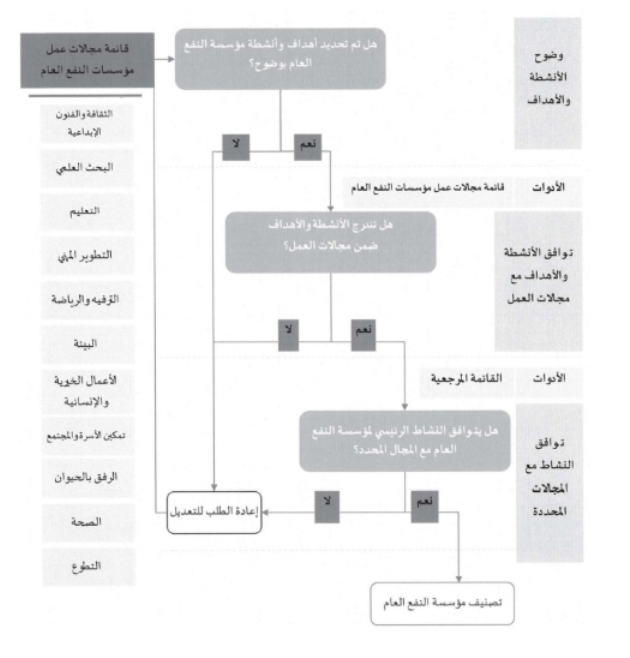
11. Results of the decision-making process
The decision-making process will result in one of the following outcomes:
a. Approval of the Classification of the public benefit Organization.
b. Requesting the public benefit Organization to amend its activities and scope of work to comply with one of the approved areas.
Results of the assessment of areas
1. Classification of public benefit organisations
- This decision is issued if the public benefit organisation's application passes the initial assessment of its objectives and activities.
- The organisation's application then moves on to the next stages of the registration process, which include additional checks and reviews to ensure compliance.
2. Return of the application for correction:
- This decision is issued if there are errors or observations that can be corrected in the public benefit organisation's field of work or activities (e.g. activities and objectives do not match the approved fields of work).
- The application is returned to the public benefit organisation with the observations, allowing it to correct the errors or provide the additional information required for approval.
12. Assessment of the current Classification process:
The Ministry will review and evaluate the current Classification of Public Benefit Organizations in accordance with the new Classification system as follows:
